Bitcoin Tech Talk #292
This is a paid newsletter. If you’re an open source contributor to Bitcoin projects, please email me with your contributions and I will give you complementary subscription.
What I've been working on
Rent-Seeking - I wrote a long screed about how altcoins are rent-seeking vehicles and how society itself has become more meaningless because of the availability of money-printing. I make the argument that we haven’t pushed the frontier of humanity because of all the rent-seeking opportunities. Bitcoin brings us back.
Stephan Livera Podcast - It’s been ages since I’ve been on his podcast. We talked about airline miles, financial games, altcoins and the desirability of rent-seeking. It was an enjoyable talk and if you’re a fan, I would encourage you to listen to the discussion.
London Real - My interview with Brian Rose is up! I really appreciated the breadth and depth of topics we covered on this one. I talked about the IMF, El Salvador, my faith and much more. The main message I wanted to convey was one of hope, which I think Bitcoin provides.
What I'm up to

A Sustainable Financial World - I’ll be at the Oslo Freedom Forum next week and my panel will be with Jeff Booth and Obi Nwusu. We’ll be talking about the financial sustainability of the current fiat monetary system and the hope for resistance with Bitcoin. I will also be helping with the Bitcoin 101 workshop for activists to learn how to store their Bitcoin safely about 15 minutes after this session.
BIP32/BIP44 Workshop - I’ll be doing a 2-hour workshop at Bitcoin++ on June 7 or 8. This will be a similar style as my 2-day course, except it’ll be just a single topic, and that of deterministic private key generation. I’ll go through the specification, derivation and the math to show how private keys can be more or less infinitely generated through this standard.
Watching LUNA - You can click through the tweet thread I made about the hyperinflation of LUNA in the Tweet of the week, but that was one mesmerizing thing. I have a podcast that I’m recording with Cory Klippsten coming up where we’ll talk about that and other things. This is one of the defining moments of this cycle and you will see more content from me about it.
Tweet of the Week

What I’m Shilling

Unchained Capital is a sponsor of this newsletter. I am an advisor and proud to be a part of a company that’s enhancing security for Bitcoin holders. If you need multisig, collaborative custody or bitcoin native financial services, learn more here.
Bitcoin
ROAST - This is a paper from some researchers that figured out how to wrap FROST around a robust and asynchronous protocol, making k-of-n signing much more useful. The characteristic of robustness means that if k honest signatures are sent, the threshold signature will always succeed. That is, it’s tolerant of faulty or even malicious signatures by some of the parties. This is in contrast with FROST which requires restarting the protocol if any party creates a malicious signature. The main change is that there are concurrent sessions sent to each signer and a lot more signatures get exchanged. The tradeoff is that this is a 2-round protocol that is guaranteed to succeed if k honest signatures come back.
OP_TX - Rusty Russell has an alternate covenants proposal which is a combination of Russell O’Connor’s OP_TXHASH and Jeremy Rubin’s OP_CTV, but more granular. The proposal has very much an inside baseball feel to it as it’s making some compromise between two proposals that an outside observer will have some difficulty understanding.
Explaining Covenants - Buck Perley writes a long article on covenants on the Unchained Capital blog. He goes through the history, the different proposals, the drawbacks and CTV-specific commentary. The main thing I got from the article is the usefulness of vaults. You can essentially create a system where certain procedures have to be followed in order to unlock your funds. For any organization, these types of controls are very desirable.
Lightning

Be Someone Else’s Bank - Darthcoin shows how you can essentially run a Lightning bank using LNBits. The idea is that you will run your own LN server and let your friends and family use your server to transact on the Lightning Network. They will need to deposit and trust you, and withdrawals are done using Submarine Swaps. The idea is interesting because there are always going to be people that don’t want to deal with setting up a node. Using an already existing trust relationship seems like a good idea.
Lightspark - It’s not clear what this startup is going to do, but they’re clearly doing something in the Lightning ecosystem. This is noteworthy because it’s headed by David Marcus, former CEO of PayPal and driver of Facebook’s Libra token the past few years. I suspect he’s realizing this is where a lot of development will take place, given the large number of servers and peer-to-peer network communications that go on there already.
LN Router Profitability - Steven Ellis shares his statistics and profit from running his Lightning Node. The economics are very interesting as it’s going to be about 6 months to break even. This is similar to mining, but doable on a much smaller scale at the moment. Maybe routing is the new mining? When I start seeing FUD articles on LN routing, I’ll know it’s arrived.
Economics, Engineering, Etc.
LUNA depegged - The LUNA people are learning what central banks have learned, which is that competing against a peg is really, really hard. The crash in BTC came from their defending of the stablecoin peg, but with a 20% interest rate, it was never sustainable. Here’s the lesson the market is teaching: however solid the protocol or exchange mechanisms may seem, the market will figure out your game and will punish you for it. At one point the supply was doubling every 18 minutes. Their reserves went from over $4B in assets to $88M, all spent defending the peg. They failed rather spectacularly with a 9000x supply increase, at which point they suspended convertibility. Sadly, a lot of traders got wrecked not knowing the supply was increasing.
Stablecoin designs - Arthur Hayes opines on the different designs of stablecoins and why LUNA failed. He brings his macro perspective on the whole thing and hits on a lot of different issues related to the fundamentals of the macro environment we live in. His perspective is one of the market being a confidence game. Always an interesting read and Hayes does not disappoint.
Coffeezilla - New Yorker Magazine has a profile on one of the few people who is exposing crypto scams. Honestly, I gave up on this endeavor years ago as people just don’t listen, but he’s fighting the good fight. He owns Bitcoin and sounds like a Bitcoin maximalist and really investigates these things in depth. After what happened with LUNA this week, I imagine we’ll see a lot more of this stuff, especially if this stuff can get shorted.
Political Left Warming Up - The article is written by someone who considers herself progressive, so it’s heartening to learn that she sees government control of money resulting in expanding wealth inequality. If progressives are starting to see the light when it comes to Bitcoin, I think we’ve won. But then again, there’s a lot of scared politicians on the left that are afraid of the environmentalist FUD against Bitcoin.
Quick Hits
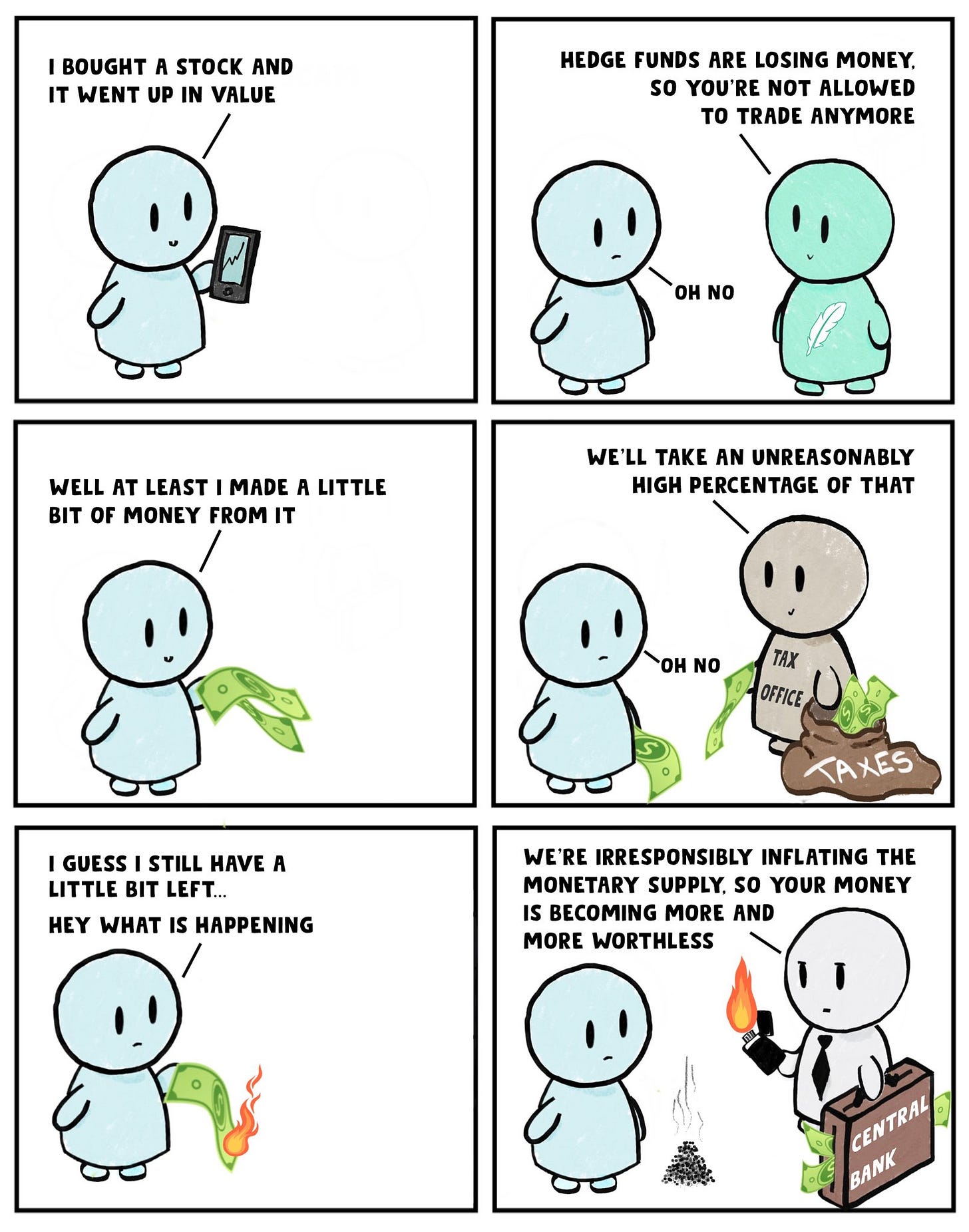
WallStreetBets is losing - Reality has a way of smacking down Nietzchean power-plays.
Demographic collapse - I’ve been wondering since COVID how many aggregate statistics are manipulated. Population might be one of the most manipulated.
No Cap Gains in Germany - At least if you own Bitcoin for a year.
IQ keeps getting lower - Study found that IQ increased until 1975 and then started decreasing. Gee, I wonder what happened?
Bitcoin City Plans - El Salvador’s new city plans look pretty spectacular.
Fiat delenda est.