
Bitcoin Tech Talk #475
Interesting Stuff

Fidelity Loss - has one of the most original explanations of the birth rate collapse that I’ve seen. The main idea is analogous to AI model collapse, where if AI trains too much on AI output, after several generations, becomes nonsense. The reason is because the outputs tend to overweigh what’s popular, slowly destroying minority information with each generation, ultimately creating nonsense. Similarly, people training too much on artificial outputs also collapse as dominant propaganda results in loss of minority information. Artificial inputs result in bad programming ultimately preventing reproduction. The idea speaks to the importance of first-principles thinking which reinforces the full picture which is needed to prevent generational collapse.
In Defense of the Hipster - makes a pretty convincing defense of the very Millennial phenomenon of hipsters. As he points out, while the whole culture was a complicated social status game, it had the virtue of creating more taste, and thus more beauty, than the subsequent Gen Z’s more ostentatious and obvious status games. The article laments the lack of taste now that hipsters are no longer cool, defeated by charges of bigotry of various forms. The main observation for me is that current culture is almost inevitably a reflection of the status games that hold sway, which in turn is dependent on the technology that people use.
Wrong Incentives - has a great explanation of how expectations of the future change the game theory outcomes of entire generations. The rhetorical question posed is put in the form of the Marshmellow Test. What is the rational thing to do when you’re unsure about the credibility of the person promising the two marshmallows? What if there aren’t two marshmellows at the end? Then what? The cycle of distrust is where players in such a game get into a vicious cycle where stealing from each other and spending resources on defenses makes sense. It’s an all-too-familiar situation in many developing countries where theft and walls of various kinds are common. Unfortunately, as the article implies, the current western situation is rapidly degenerating into such a vicious cycle, largely due to the collapsing entitlement systems.
Property Rights - has a powerful essay about the situation in Israel and Palestine and how the root injustice is a disregard for property rights. As he shows, Israel is unique in only allowing ownership (really, government rental) of land based on religion. Jewish people can own land while Arabs cannot. Further, the ability for Jewish settlers to take houses of Palestinians with government permission is largely what causes all of the enmity. As analyzed in the last story, the tit-for-tat in a game like this will continue indefinitely because it’s the only equilibrium when such a policy is applied. A property-rights system encourages the cooperative equilibrium.
American Revolution Revisionism - James Perloff has a revisionist history long-read of the American Revolution and it challenges a lot of assumptions. Did the colonists fake the “Boston Massacre?” Was the first shot really fired at Lexington? What were the motives of John Hancock in signing his name with large letters on the Declaration of Independence? Were Sam Adams and Paul Revere the heroes? The evidence here about all of these events were new to me and have a little more credibility given how history is generally written by the winners. As with most stories, the one we’re given by history is made out to be good vs evil when it’s a lot more nuanced.
What I'm up to
Core v. Knots part 5 - Tone and I talked to Knut here about the economic aspects of this debate, particularly whether we can really price data storage properly when it’s going to be around forever. Knut argued that such data has higher cost the lower time preference you have, and that the core devs have priced such data too low given its permanence.
Core v. Knots part 6 - Tone and I talked to Giacomo about the mistakes on both sides as a somewhat neutral commentator on this debate. We talked about principled vs utilitarian positions, whether devs would admit any mistakes and what attack surface the OP_RETURN might open up. We also talked about the CSAM issue and the possible ways in which both sides can save face.
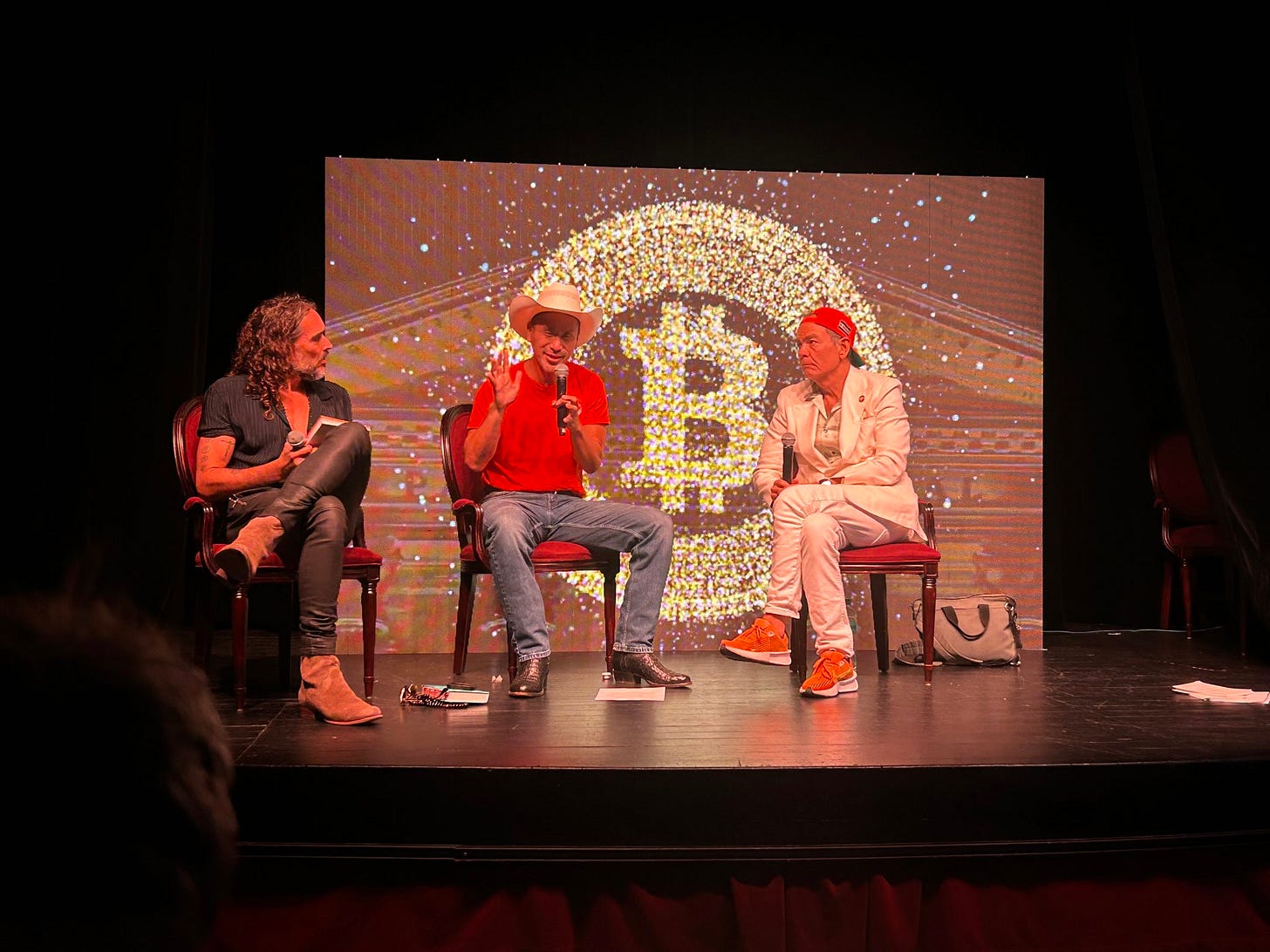
Bitcoin Historico - There were a bunch of videos that were recorded, including one with Russell Brand above, a panel about paper Bitcoin treasury companies and my talk on Noblesse Oblige, but they’re not quite out yet. Stay tuned, though, because it was an amazing conference.
Nostr Note of the Week
What I’m Promoting
Bitcoin

Multisig Recovery Checklist - Multisig using hardware wallets is the most secure way to self-custody Bitcoin currently out there. Unfortunately, not enough people understand all the responsibility that goes with creating such vaults, and this post goes into what maintenance multisig wallet owners should go through. In particular testing your setup and your backups are critical parts of your setup and it’s not a set-it-and-forget-it thing which is so common in the fiat world. I appreciate posts like this as it emphasizes the human fallibility of self-custody and recommends specific actions to mitigate it.
Miniscript Benefits - Miniscript makes much more accessible the somewhat opaque language of Script into something much easier to reason about. The article goes through the many privacy benefits, especially using Tapscript. For me, the much harder part of Miniscript is making clear to the user what they’re locking the script to. Anything beyond a simple majority multisig is difficult to convey the security risks and is a lot more like understanding code. Historically such efforts to push up programmatic reasoning to users unfamiliar with the concept generally fail. That said, perhaps the motive here is strong enough to succeed.
BIP39 Dice Roll - Generating a seed phrase is undoubtedly tedious. Most people are not used to rolling dies many times and get annoyed. Yet trusting a computer to randomly generate stuff is not great either. This is something in between where you can download the page offline and have the computer generate the phrase while showing you what the dice rolls were. A computer can, of course, look at a phrase and show you dice rolls that compare to it, but the code is there for you to examine, so perhaps it’s better and you can validate the rolls correspond to the words.
Lightning

Lightning Custody Spectrum - We would like to believe that Lightning funds are binary, that is, self-custodied or non-custodial, much like it is on-chain. But due to the way that Lightning works, it’s not that black and white and this article helps explain the various degrees of self custody. The article goes through how malicious channel closes, revoked states and fee manipulation mean that there are more ways to compromise Lightning channels than on-chain transactions and concludes that the separation of node and private key are what’s really required for true lightning self-custody.
CandyPi - This is a fun project to dispense candy based on lightning payments. It’s obviously more costly than the coin-operated equivalents as they require an internet connection and a place to display the lightning invoices, but I would certainly appreciate the removal of the correct change requirement. There have been many projects like this, which create lightning invoices, some offline. Once a style becomes standard and there are enough lightning payers, I can see this becoming a great way to have merchant-fee free vending machines.
time2build - This is a cool contest for lightning devs where the prizes are $25,000. It looks like the main reason is to show off the Breez SDK and to build some buzz around their API. The nice thing about online contests like this is that you can solicit projects from around the world instead of whoever happens to be around for a hackathon, and I hope there are entries from some of the developing countries that they’re targeting.
Economics, Engineering, Etc.

Lava Saga - Back in October 2023, this Bitcoin lending platform did something pretty innovative. Lend out money using Bitcoin as collateral and show that the Bitcoin was not being rehypothecated by using Discrete Log Contracts. But then they raised $200M and changed their model completely to a custodial one, which means that the Bitcoin can, indeed, be rehypothecated. Now, changing business models, especially as new investors come in is completely normal in the startup world (what they call a “pivot”) but the manner in which this company changed the service was to not make this change known to the user at all. A shameful episode and hopefully, not the beginning of something more nefarious.
Square Bitcoin - Jack Dorsey’s payments company has now enabled Bitcoin integration for their ubiquitous point-of-sale system. You can now pay using Lightning to any vendor using Square, and Miles is offering $25 to the first person at each merchant to accept a payment in Bitcoin. This is on top of the other major innovation, which allows the CashApp USD balances to pay Bitcoin invoices. The main complaint seems to be the BIP177 integration, which renames satoshis as bitcoins, confusing a lot of people.
Prince Group BTC Claims - The Prince Group was a ponzi scheme that was being operated by a Cambodian national that managed to collect 127,000 Bitcoins. These coins were seized by the US government and is now being claimed by the Chinese government, going so far as to call the coins “stolen” by the US government. The $12B or so in USD terms is not a big amount for governments, but conflict over seized Bitcoins is bound to become an international incident in the years to come.
Quick Hits

ZEC pre-2018 - Is apparently very difficult to transfer, perhaps revealing exactly why the thing is pumping. Their updates may have locked out a lot of early holders!
Epstein Contributed to DCI - This is according some emails from the Epstein estate, back when DCI funded Gavin Andreesen, Van der Laan and Corey Fields in their Bitcoin Core work.
Harvard IBIT - The university endowment fund has more in IBIT than any stock, worth $442M dollars.
Czech National Bank - The central bank of the Czech Republic has opened a $1M Bitcoin position as a test.
Fiat delenda est.