
Bitcoin Tech Talk #476
Interesting Stuff

Chinese Empire - One of my favorite book reviewers has a review out about China and its long history of being an Empire. It was, for me, a deeply insightful review, writing much about the historical mentality of the region as a way of explaining its historical pull toward a single nation. To summarize, idea of “all under heaven” looms large over Chinese history and Confucian identity and the scholarly/intellectual class has, over thousands of years, created a society that values unity, even under a foreign sovereign (!) The mentality explains, for example, the large minority in Taiwan that want to unify with the mainland, despite having the large historical enmity. The intellectual environment of China throughout history, as the article argues, truly impressive and has shaped it to what it is today.
Singleness Glorified - has another insightful article on the current societal pressure on young women. Specifically, she makes the claim that the pressure is for young women to stay single, rather than have a serious relationship. The conventional wisdom, of course, is the opposite, that they are pressured to get married and have children, which may have been true 30 years ago. As she points out, the expectation is that young women live an entire life in their 20’s before settling down, having a career, finding themselves and so on. It’s an inversion I hadn’t thought of, but rings true and contributes greatly to falling fertility rates.
Bad History - writes about the many ways in which modern historians get US history wrong, both liberal and conservative. The main complaint is that history focuses way too much on Washington DC, which for most of US history didn’t matter to most citizens because the federal government was so minimal. He also chastises the conservative historians’ tendency to take the liberal historians’ stances on a lot of historical figures like Lincoln, Teddy Roosevelt and more. Lastly, the actual things that mattered, like religion and family are rarely covered, yet had an enormous impact, particularly with respect to the culture that developed in the US. For me, historical revisionism around a lot of historical figures, particularly those around deified ones like Lincoln and FDR are valuable for this reason.
Denying Death - writes about the modern, and not-so-modern movement to not die. It’s an ancient movement because such desires to live forever is part of every culture’s myth, but it’s modern in the sense that the Bryan Johnsons of the world are attempting to do this through “science” and live as though living forever is not just possible, but probable. As he points out, the sad thing about the modern tendency is that it’s a deep existential burden they have as a result of a materialist metaphysic. Without meaning, living forever is about the only thing to live for, which is a weird kind of circular logic. As every culture has discovered, some deeper meaning is a life necessity.
Building Beauty - has a new book out about family dynasties and what’s unique about them. As he points out in the article, the 1000 wealthiest families from 1900, if they had invested and gotten normal returns while reproducing normally should have, by 2025 should have resulted in 16,000 billionaires, but there are only 700 in the world, suggesting something amiss. Part of it is the enormous growth of government, of course, but there’s also the distinct lack of culture around these families which have led many of these descendants to squander the wealth left to them. The article is a distillation of what successful families, the ones that last many hundreds of years do differently.
What I'm up to
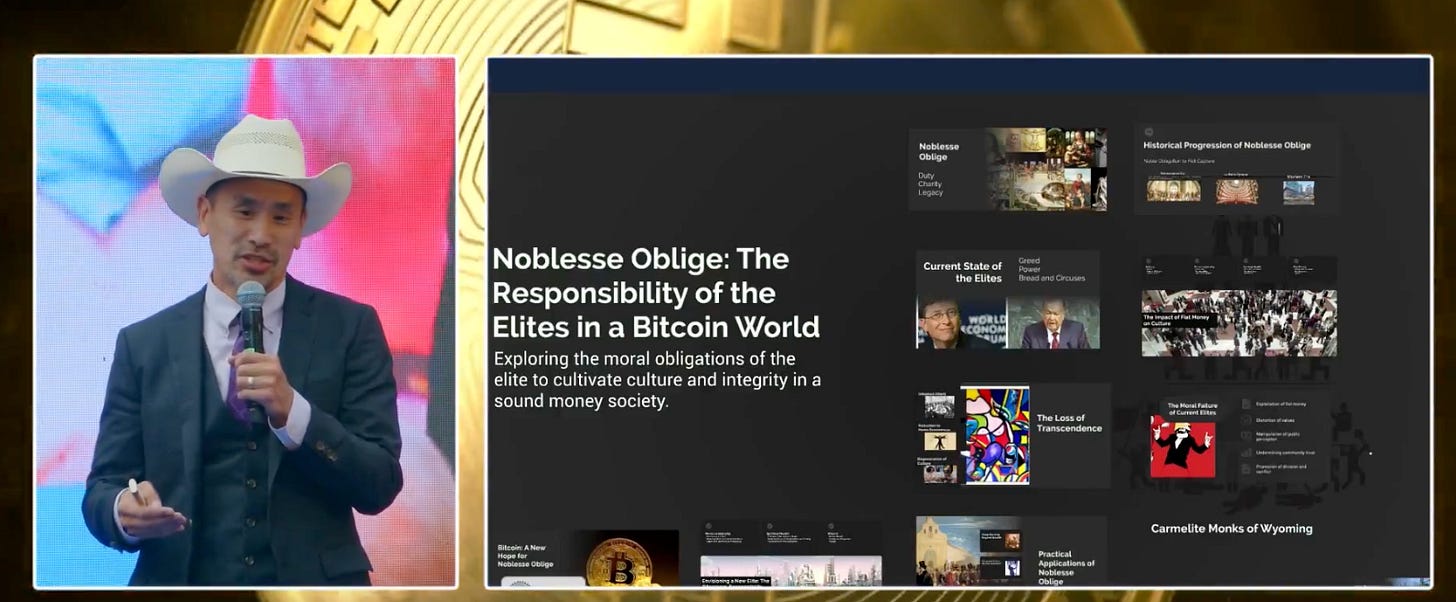
Noblesse Oblige - This is my talk from Bitcoin Historico, similar in theme to the last article in the above section. I argue that the current batch of elites are the worst in history, abusing the public purse for their own benefit and essentially stealing from the populace, and that the reason for the lack of beautiful things is fiat money. Under Bitcoin, we can and hopefully will build up civilization instead of eating its seed corn.
BitBlockBoom - This is a conference taking place in Fort Worth, TX next April. This is the next Bitcoin conference that I’m scheduled for at the moment, but it should be a banger. There is a Thank God for Bitcoin conference that will happen around the same time and I will be speaking at that as well.
Thank God for Bitcoin Second Edition - We are nearing completion on the second edition of Thank God for Bitcoin. We have a new foreword and some updates that have become dated in the book. Stay tuned for some goodies that we’ll be offering.
Nostr Note of the Week

What I’m Promoting
Bitcoin

Security Audit of Bitcoin Core - Brink has paid Quarkslab to conduct a first-of-its-kind security audit of Bitcoin Core. The actual process was mostly around code review of existing code with the help of a couple of Core devs who could explain to the reviewers what various components did. Through about 100 days of code review, the reviewers found some improvement suggestions, mostly around fuzz testing and multi-threading. I personally think more review of existing code is warranted and necessary and hope more of this sort of thing happens, particularly with new contributors to Core.
BitVM Mod Proposal - Supertestnet comments on what he assesses to be an expensive way for BitVM to run their sidechain. Both Citrea and Alpen Labs plan to publish the state changes of their sidechains in Bitcoin itself. This is necessary for users to unilaterally exit as the user needs to know the current state of the sidechain to do so. Yet this is horribly inefficient as each state change gets recorded rather than merklized, which is what supertestnet is proposing. Sadly, it looks like these sidechain proposals aren’t that concerned with making good technical choices that would benefit Bitcoin and instead are in MVP mode.
Angor - Non-custodial crowdfunding is something that has been talked about in Bitcoin for a long time, going back to 2011 when Mike Hearn was proposing using SIGHASH_ANYONECANPAY to do something like that. It hasn’t gained much traction because, as it turns out, not too many people are that interested in crowdfunding projects with the complicated UX that usually result. This is a project trying to make this better to crowdfund worthy projects. I’m not sure how popular this will be, but it’s good to see if there is such a market.
Lightning

Coinsnap - As much as we like using lightning, the payment experience is still not great. This is a project to help integrate lightning in a better way into normal customer flows online. Much like Zaprite, they integrate accounting tools to help keep track of all the sales and invoices and so on. Between this, Zaprite and Square integration, Lightning really does seem to be coming into its own as a method of payment.
Mobile Nodes - Voltage has this honest assessment of Lightning problems for a lot of different use cases. In particular, they identify invoices and off-line payments as large weaknesses in the ecosystem that hinder adoption as they are not normal user flows within Lightning. As such, they are proposing mobile nodes with all the goodies of BOLT12 to make things work much more intuitively.
Cash App Receive BTC - You can now invoice dollars on cashapp but receive lightning payments! This is something like an insta-buy for any money owed to you on the app. As the app is very popular for p2p transfers (say splitting a bill at dinner), this can potentially be hassle-free way for a lot of people to get Bitcoin exposure. I know for me, getting people to buy some is often tortuous, but paying them in Bitcoin for money I already owe them can be potentially a better way.
Economics, Engineering, Etc.

Stretch Economics - Great analysis of MSTR’s most popular alternative financial instrument, STRC, colloquially called “stretch.” It’s a very new type of financial instrument in that the price is supposed to hold steady while the dividend varies. This is a blend of various different types of assets like money-market funds combined with a bond that pays a coupon. As the article shows, however, there are ways for MSTR to get out from the high yield they are paying out (~10%/yr) and likely won’t necessitate sales of Bitcoin.
Liana Business - Institutional self-custody is something very few companies even attempt, some due to regulatory requirements, but largely because the tools available are often clunky, expensive and non-standard. This is a product aimed at solving this problem by creating a wallet specifically for multi-person control for something like corporate and non-profit entities. There have been products like this in the past (Armory had one 10 years ago) but oftentimes, it requires companies to identify the problem and suffer pain before such products become popular.
Wavespace - Living on a Bitcoin standard can be painful, largely because there’s always friction moving money in one direction or the other. This is a product that helps people in the EU make that a lot easier with something called the Wavecard. The idea is that you can buy or sell Bitcoin from your self-custodied Bitcoin wallet anytime, making bank account management easier and faster. More details about the product here.
Quick Hits
Don’t Get Kidnapped - The Gray Lady has opined on Bitcoin ownership risks with regard to wrench attacks and kidnapping and actually has some decent advice.
$1.3B - A whale from 2011 has sold his entire stash for this amount, supposedly.
Scammed - The CEO of SazMining got played for $200k, a low amount considering.
De Minimis - Square is lobbying for this exemption to make Bitcoin more a method of payment.
Fiat delenda est.