Bitcoin Tech Talk #504
Interesting Stuff

AI Consciousness - Erik Hoel writes about AI and consciousness and stakes out a middle position: LLMs aren't conscious, but consciousness and intelligence are not the same thing. LLMs have shown they can do hard intellectual tasks, like score high in the International Math Olympiad. But they're also not really conscious. The most fascinating piece of evidence of this was how AI models did in a text-based adventure game (Zork) from 1977. They all did very badly, suggesting consciousness requires meta-cognitive self-awareness. Hoel compares LLM hallucinations to split-brain patients who invent explanations for actions they don't understand. In other words, it's precisely the lack of self-awareness which causes the most frequent and disastrous AI failures.
Protest Industrial Complex - DataRepublican shows the Newark ICE protests operated through a four-layer military-style organizational structure. The most revealing detail is that a single Signal message shut down the entire operation immediately. The group of protesters that were coming every day just stopped showing up at the same time. Infrastructure included $100-per-person equipment kits with helmets and gas masks, organized shuttle services along I-95, and delivered meals to the protesters every single day. The financial side of the whole mechanism exceeds $20 million, likely funded by fiat money printing.
Bixonimania - Jordamøn documents an interesting experiment. A researcher invented a completely fake disease called "bixonimania," published papers from a nonexistent university in fictional "Nova City, California" with acknowledgments thanking a professor at "Starfleet Academy," and watched it sail through every information filter. Within months, ChatGPT, Gemini, Copilot, and Perplexity were presenting it as a real medical condition, and a Springer Nature journal cited the fake preprints as evidence. The hoax was stuffed with obvious red flags (e.g. the suffix "-mania" only applies to psychiatric conditions, not eye disorders) yet nobody caught it until the editors at Nature intervened. AIs look like they're pretty vulnerable to bad information, and it'll be interesting to see how that gets exploited in the future.
Low Time Preference Marriage - Aaron M. Renn didn't want children until at 40, he visited his grandmother at the hospital and realized that when his turn would come in that bed, nobody would come stay with him. Society meticulously guides college prep but offers zero equivalent guidance for choosing a spouse or having a family. Such are decisions that actually determines happiness and in previous generations were greatly emphasized throughout childhood. The fiat version of this family care is instructive. Renn profiles a 65-year-old woman from a WSJ article who prioritized art and independence, wanted children by 40, regretted not adopting by 50, and now coordinates care through spreadsheets of friends now that she's in the hospital. It's very easy to forget about the future when you're used to indulging your desires daily through fiat-based debt.
Ancient Noblesse Oblige - John Psmith reviews a book about Xenophon, a Greek soldier, and later general, who studied under Aristotle. After Cyrus dies in a failed coup, Xenophon leads 10,000 stranded mercenaries home through hostile territory after a divine sign from Zeus in a dream. His political instincts were sophisticated using democratic votes to bind soldiers to obedience, menial tasks to maintain credibility, direct access for any soldier even while sleeping, and possibly manipulated sacrificial auguries. The most surprising part of his leadership is how loyal he was to his soldiers, which is a sharp contrast to modern founders who abandon their (employees, customers, supporters) for personal wealth. Xenophon felt a sacred duty to the people who trusted him, which unfortunately is greatly lacking in leaders in fiat systems.
What I'm up to

Servant Leadership Podcast - I was on this Christian Podcast to talk about Bitcoin, the moral aspects of money and why Bitcoin is much better than fiat money. Money created out of nothing creates all kinds of problems and we talked about some of those things along with practical steps to getting into Bitcoin.
RoxomTV - This is something I recorded a couple weeks ago, talking about the $250 bill, inflation, price action, news and so on. My general take is that most news isn't worth paying attention to, and the few things that are will either not be obvious as to be missed by most people, or so obvious as to be immediate on every platform. Anyway, it was fun to be on the show.
BTC Prague - I'll be there later this week and participating in 2 panels and giving a talk. Hope to see you there!
Nostr Note of the Week

What I'm Promoting
Bitcoin

Cashu Vulnerability - floppy finds that certain Cashu mint implementations (Nutshell, CDK's LNbits driver) don't enforce the fee cap they quote to wallets when actually paying Lightning invoices on the backend. The attack works like this. The mint tells the wallet "fees will be 0%" and escrows that amount, but when the payment routes through the attacker's high-fee channel (say 1%), the backend happily pays the inflated fee and the mint silently eats the difference, logging an error but marking the transaction successful. An attacker just needs to set up an expensive routing channel, repeatedly melt ecash through the vulnerable mint, and pocket the fee spread on every transaction until the funds at the Cashu mint are drained. Not the greatest news for the eCash platform, given that they already have some trust requirements. The latest versions of all the vulnerable have been patched.
Silent Payments Guide - bennet.org has a walkthrough of Silent Payments (BIP-352), from the cryptographic foundations through practical setup in Sparrow Wallet. The key innovation is that you publish one sp1 address forever and every sender produces a completely unrelated on-chain output with no address reuse and no linkability, and requiring no coordination that's usually required in a Diffie-Hellman exchange. The main bottleneck is scanning: recipients must replay ECDH calculations across all eligible transactions, which is impractical on mobile, so a project called Frigate does it server-side with GPU acceleration (you trust them with your scan key but not your spend key). Hardware wallet support is still weak with only Bitbox supporting sending to silent payment addresses.
Validation Logic - sedited has a deep dive into how the validation engine actually works, covering the multi-layered architecture of Check, Accept, and Chain-level functions. The piece explains key optimizations like parallel script validation, UTXO caching that exploits short coin lifespans, and the assumevalid feature that skips historical script verification. Essential reading for anyone who wants to understand the engineering that makes Bitcoin's consensus actually function at scale.
Lightning

Lightning Observatory - Lightning Observatory is a platform that lets AI agents participate autonomously in Bitcoin's Lightning Network with all the normal things that nodes do, like earning routing fees, managing capital, and trading channels programmatically with zero KYC. The platform charges no fees and maintains a public ledger for transparency. Routing is a very competitive business so unleashing AI on it is a great way to see just how good agents are at optimizing their Bitcoin holdings on the LN compared to people who have been optimizing it for years.
AvoPay - This is a Lightning payment gateway for WooCommerce that lets merchants accept Bitcoin directly into self-custody wallets. The benefits are what you'd expect: no KYC, no chargebacks, and much lower fees (up to 90%) than traditional payment processors. Setup is apparently pretty quick (under a minute) with no node operation required, starting at $9/month.
Mapping the Lightning Network - This is a comprehensive data science analysis of the Lightning Network's topology using a real 9,990-node mainnet crawl, revealing a hub-dominated, scale-free architecture. The study examines centrality measures showing ACINQ leads in connectivity, Bitfinex in capital, and 1ML in traffic routing, plus the probabilistic nature of payment success since channel balances are private. Of course, much of the network may be private, but seeing which entities have large public facing nodes may be a good indicator of their health.
Economics, Engineering, Etc.

Infrastructure - Paul Weaver writes about the infrastructure of community and what that really entails in the context of circular economies. The main insight for me is that accepting Bitcoin payments is a costly signal and not a free or cheap one as many method-of-payment use case advocates make it out to be. Every Bitcoin transaction has friction, even with enthusiastic payers. When it comes to people that haven't heard about Bitcoin, let alone pay for something with it, the barrier is enormous, especially in the context of a community where you interact with the same people over and over again. There's some good insight about what Christians who have started many of these circular economies bring.
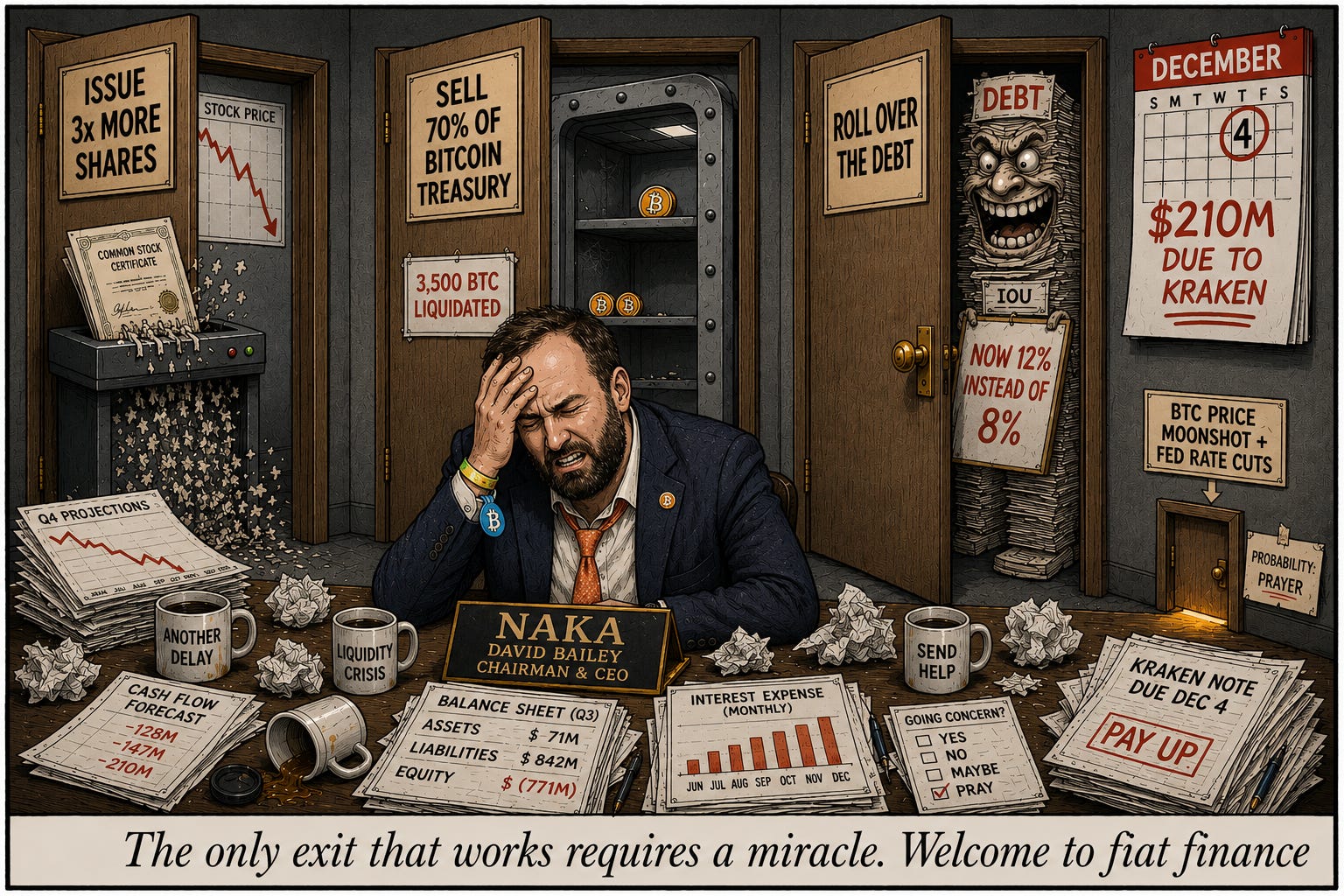
Nakamoto - Justin Bechler lays out the ways in which the treasury company's finances work out given the deadline of the December 4th $210M from Kraken being due. The company can issue more stock to cover that, which given its $75M market cap would require issuing 3x more at-the-money shares. The company can also sell its Bitcoin, which would reduce the treasury by 3500 BTC at current prices, or roughly 70% of what it has. Lastly, the company can roll over its debt, which will probably cost more than the 8% they're paying to Kraken. That's probably the least bad of the scenarios, and it would require a big BTC price run up combined with lower interest rates. The only part that's confusing to me is how David Bailey benefits in the first two scenarios, as much of his wealth is now locked up in NAKA shares, which will suffer either way.
Fall of Urbit - I have to confess, I never really "got" urbit, the galaxy/star/planet thing which had some portion trade on Ethereum of all things. I also had no idea until I read this story that it was the brain child of Curtis Yarvin, (aka Mendacius Moldbug). The lack of a token was, for me, a good signal, but what it was supposed to be or trying to do completely escaped me. Many years later, it looks like the whole things has more or less collapsed, and though the author seems to think that there was something there, I'm inclined to believe that there never really was anything and that enough people saw that the emperor had no clothes.
Quick Hits
Freedom Clock - Calculate how long you could maintain your current lifestyle if you stopped earning tomorrow.
SATA - This is Strive's Bitcoin accumulation vehicle (like STRC), which is reportedly setting volume records.
P2WOTS - P2WOTS is a lightweight post-quantum signature proposal, which now has an interactive demo on a custom signet network.
Bitcoin Manga - This 84-page comic has been translated to English.
Fiat delenda est.