
Bitcoin Tech Talk #511
Interesting Stuff

Everything is Private Equity - writes about how private equity has quietly infiltrated roughly 20% of the American economy, buying up everything from day cares to emergency rooms, loading companies with debt, and systematically degrading quality while maintaining prices. The statistics she cites are scary. PE-owned nursing homes show 10% higher mortality and PE emergency rooms 13% higher death rates. Fiat money continues its takeover of the economy, which started with large, public companies and has progressed down to small business. The playbook is pretty straightforward. Central banks flood the system with liquidity, financial engineers use it to buy real assets, strip them for parts, and extract rents from captive consumers who don’t even know who owns the services they depend on. The enshittification everyone complains about is just leveraged buyouts if you go back far enough.
Post-Scarcity and the Beast Of Revelation - follows the surprising Silicon Valley trend of interpreting Revelation given the current tech trends. In it, he makes the argument that the post-scarcity utopia tech bros keeps promising us is actually the system described in Revelation, where identity, money, and permission to trade all collapse into a single administrative authority. He argues that the mark of the beast made literal through biometric IDs like WorldCoin. The piece draws a sharp line from Genesis, where Adam names creation and exercises meaningful dominion, to Babylon, where the beast replaces names with numbers and work with dependency. The main takeaway for me is that abundance without agency isn't paradise and is much more akin to a prison.
Leverage Research - writes this wild story that was set to appear in The New Yorker before it was pulled, presumably because of how crazy it sounds. A bunch of Bay Area effective altruists are funded by Peter Thiel try to hack consciousness without guardrails and ended with members reporting demonic entities, paranoid "intention wars," and full-blown cult dynamics. The founder maintained power over employees' housing, visas, and romantic lives while pursuing increasingly esoteric bodywork techniques that left participants with PTSD and panic attacks. Even if you doubt the existence of spiritual reality, this story will surely give you some food for thought.
China and Housing - shows how China's real estate collapse has wiped out roughly $18 trillion in household wealth. The core problem is one Bitcoiners have been warning about for years, which is that using anything other than a monetary asset to save will significantly distort that asset’s price. Something like 70% of a nation's household wealth is concentrated in housing, was propped up by government policy and the current, inevitable correction is catastrophic. Prices have fallen for 35 consecutive months back to 2006 levels, major developers have defaulted on over $300 billion in debt, and 1.5 trillion yuan in mortgages are tied to apartments that were never finished. This is what happens when supply outruns demand via fiat money.
Putin’s Perspective - writes insightfully about how Putin is conducting the Ukraine war. He is playing what’s called Kutuzov's long game, a strategy from the Napoleonic Era where deliberate military restraint and simple waiting crushed Napoleon’s army. This is a bit of a foreign concept in the West and looks like cowardice, but there’s a cold logic to it that makes sense. He’s waiting for the West's financial house of cards to collapse under its own weight. American political cycles demand quick wins and dramatic moves, while Russia can afford to hold defensive lines for years, banking on Europe's energy crisis and unsustainable debt levels to eventually cut off Ukrainian support. Whether or not you buy the analysis fully, the underlying point about Western fiscal fragility determining geopolitical outcomes is one that should resonate with anyone watching sovereign debt levels.
What I'm up to

Ideals and Incentives - My talk from BTCPrague is out and it’s about how we treat miners versus developers. We treat one as only motivated by money and the other as only motivated by ideals. I think that’s a mistake and a realistic view of both would be beneficial to the ecosystem. And of course, the AI-generated version with Korean audio is already here.
Bitcoin Historico - This is a X Spaces chat I had with Max, Stacy and Jethro last year, which is out as a podcast episode. We talked about how Bitcoiners should be thinking a lot more long-term, which is what the conference is all about. I will be speaking again at the event in San Salvador this November.
Nostr Note of the Week
What I’m Promoting
Bitcoin

Signature Aggregation - Fabian Jahr has published a BIP on signature aggregation within transactions, allowing for the holy grail of on-chain coinjoins, Cross-Input-Signature-Aggregation (CISA). The gains in privacy are around the idea that coinjoins are economically incentivized, and it’s something that people have been talking about from before Taproot’s Schnorr signatures. I’m a little more skeptical of the benefits given the UX problems and how Taproot in general has worked out, so I really hope that there will be more time spent on the user flows of CISA to make it more practical and usable.
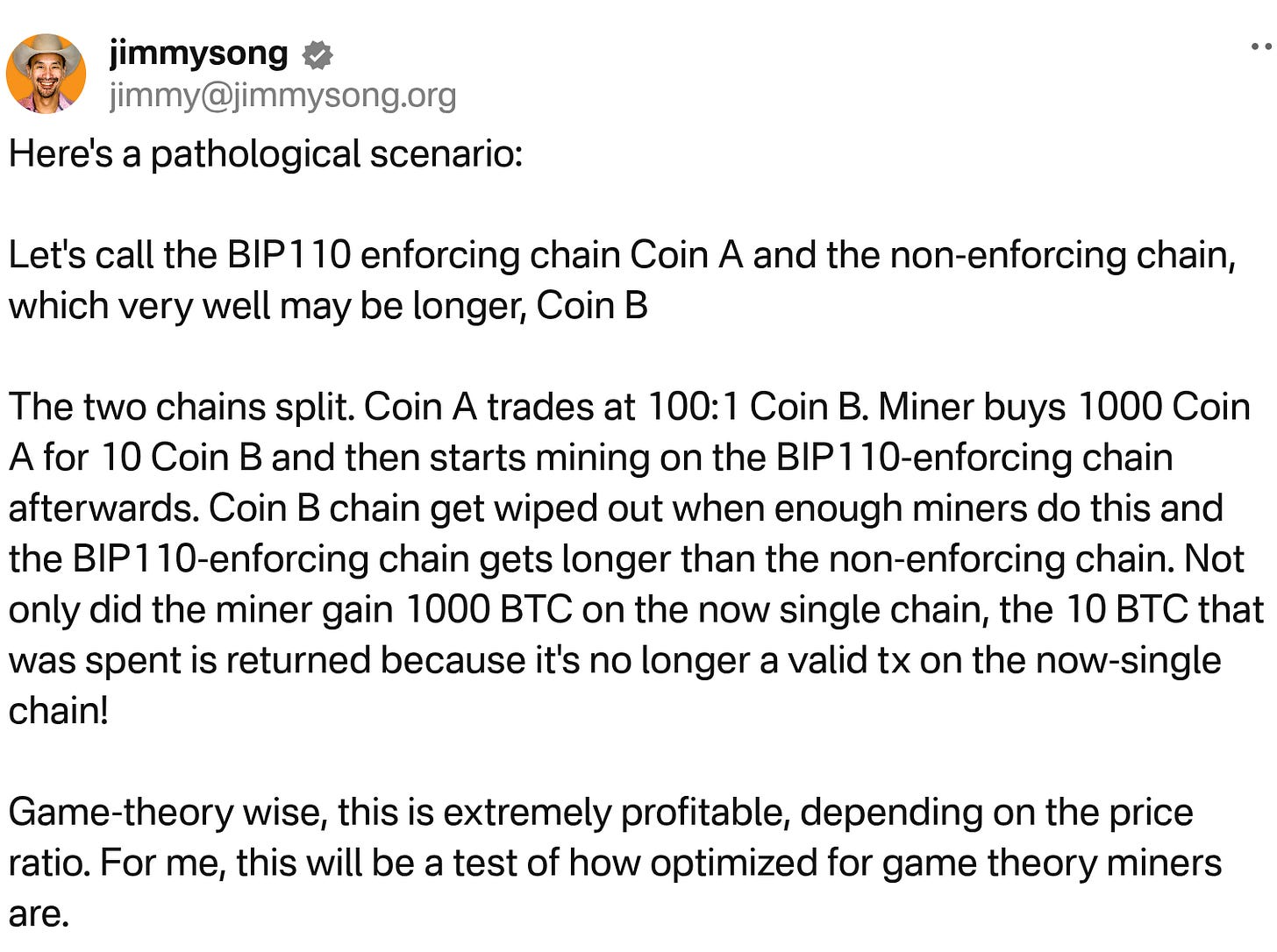
OP_PLENTY - This is a clever encoding scheme that embeds arbitrary data inside valid Tapscript opcodes by splitting each payload byte into nibbles and mapping them to opcodes via modular arithmetic, avoiding any disabled or consensus-breaking operations. The v2 framing adds a magic marker so encoded data can be located within raw transactions, making it self-describing. The demonstration is mostly to discredit BIP110 and no doubt if the BIP110 has a chain at all, this would be one of the things that someone will try to get in.
Bitcoin Inquisition 29.4 - Bitcoin Inquisition 29.4, built on Core 29.4, now activates seven proposed soft fork changes on signet for real-world testing. These include SIGHASH_ANYPREVOUT, OP_CHECKTEMPLATEVERIFY, OP_CAT, OP_CHECKSIGFROMSTACK, OP_INTERNALKEY, the Consensus Cleanup (BIP 54), and TEMPLATEHASH. Having all these proposals live on a shared test network lets developers compose them together and discover interactions before anyone even thinks about mainnet activation. I would like to see the purported use cases for covenants actually get built here and shown to be useful, though I suspect it’ll be mostly used to show that the various proposals are safe.
Lightning

Wavelength - Lightning Labs launched Wavelength, a platform that lets both developers and AI agents send and receive Bitcoin payments through a simple API. The main feature is that users retain full custody of their keys but don’t have to deal with node management, channel balancing, and liquidity headaches. The killer feature is native support for the Model Context Protocol, enabling autonomous AI agents to make and receive micropayments as small as fractions of a cent at 1 basis point versus 200-300 bps on legacy rails. If machine-to-machine payments are the next frontier of commerce, Wavelength’s self-custodial approach makes a future running on Bitcoin more likely rather than centralized payment processors.
BOLT12 Zaps - Ben Carmen proposes this PR replacing the current server-dependent zap infrastructure. By using BOLT12-based zaps that are fully self-verifying, no custodial middleman is required to prove a payment happened. It cryptographically binds Lightning payment proofs to signed Nostr zap intents, meaning clients can verify settled payments without trusting a recipient-operated server. This is a pretty significant protocol-level improvement that removes centralized chokepoints and makes Nostr’s payment layer more peer-to-peer.
Mochi - Mochi is a Bitcoin-native creator platform that lets content creators get paid directly over Lightning. The main advantage is that creators don’t need to rely on ad-driven surveillance platforms or payment processors that can deplatform them. Content creators have to depend on centralized players quite a bit, so anything in this direction is likely to be welcome, especially for the truly out-there content. In a world where YouTube demonetizes and PayPal freezes accounts at will, a Lightning-native creator platform is valuable for free speech and financial independence.
Economics, Engineering, Etc.

Tether, Elektron, XXI - The proposed mega-merger of these three companies has collapsed, with Jack Mallers stepping down as Twenty One CEO. The stock has had a rough time, cratering 40% from its May peak to $5.32. The deal fell apart as Bitcoin treasury companies “fell on hard times” with BTC’s price slump exposing the fragility of the entire model of issuing equity to buy bitcoin. Strike will now operate independently while Twenty One tries to find its footing under new leadership. This is your periodic reminder that the gap between ambitious announcements and actual execution remains enormous, even in Bitcoin.
Clams v1 - Clams is a desktop accounting app built in Rust that finally brings proper double-entry bookkeeping to Bitcoin, Lightning, and Liquid. The software is solving the maddening problem of wallet-to-wallet transfers being misclassified as taxable events. Its local-first architecture keeps your financial data on your own machine instead of some third-party server, which is exactly how financial sovereignty should work. At $199/year it is not cheap, but for anyone running a Bitcoin business or managing multiple wallets, having real balance sheets, capital gains reports, and transfer-matching intelligence is likely worth every sat.
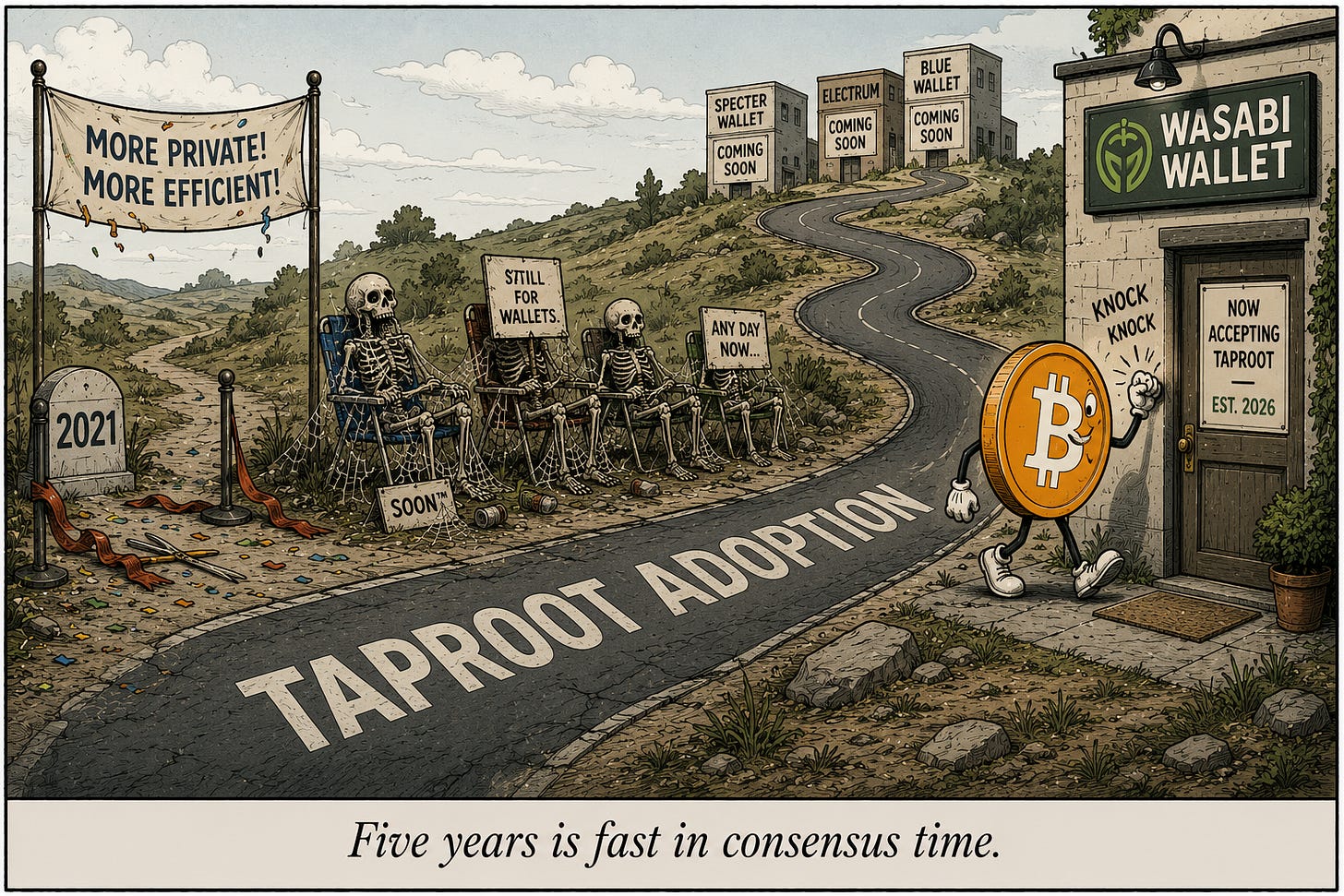
Wasabi and Taproot - Wasabi Wallet's latest release makes Taproot the default address type for receiving bitcoin. The release also ships improved sync progress visibility, Linux AppImage support, updated Tor (v0.4.9.9), and fixes for anonymity score display bugs. The fact that it took this long for a privacy-focused wallet to upgrade to a more private and efficient address type is a pretty powerful statement about Taproot’s efficacy. Perhaps we should be a little more skeptical of all the hype by developers on the new toys they get with each soft fork.
Quick Hits
Brewery Mining Bitcoin - An Australian brewery is using its excess rooftop solar energy to mine Bitcoin.
Blockvase - Blockvase is a $1,500 hardware node-in-a-box cube with a gorgeous live mempool visualization.
BIP 54 on RegTest - BIP54 is being put in, but is deliberately limited via activation to regtest only, leaving mainnet activation as a separate decision.
Saylor’s Bitcoin Rollercoaster - Even the WSJ is questioning Saylor’s broken promise of “never selling.”
Fiat delenda est.